scheduling
Schedule Your Shop Better
A practical scheduling system for auto repair shops that accounts for technician capacity, carryover, parts delays, and the 4 PM surprise.
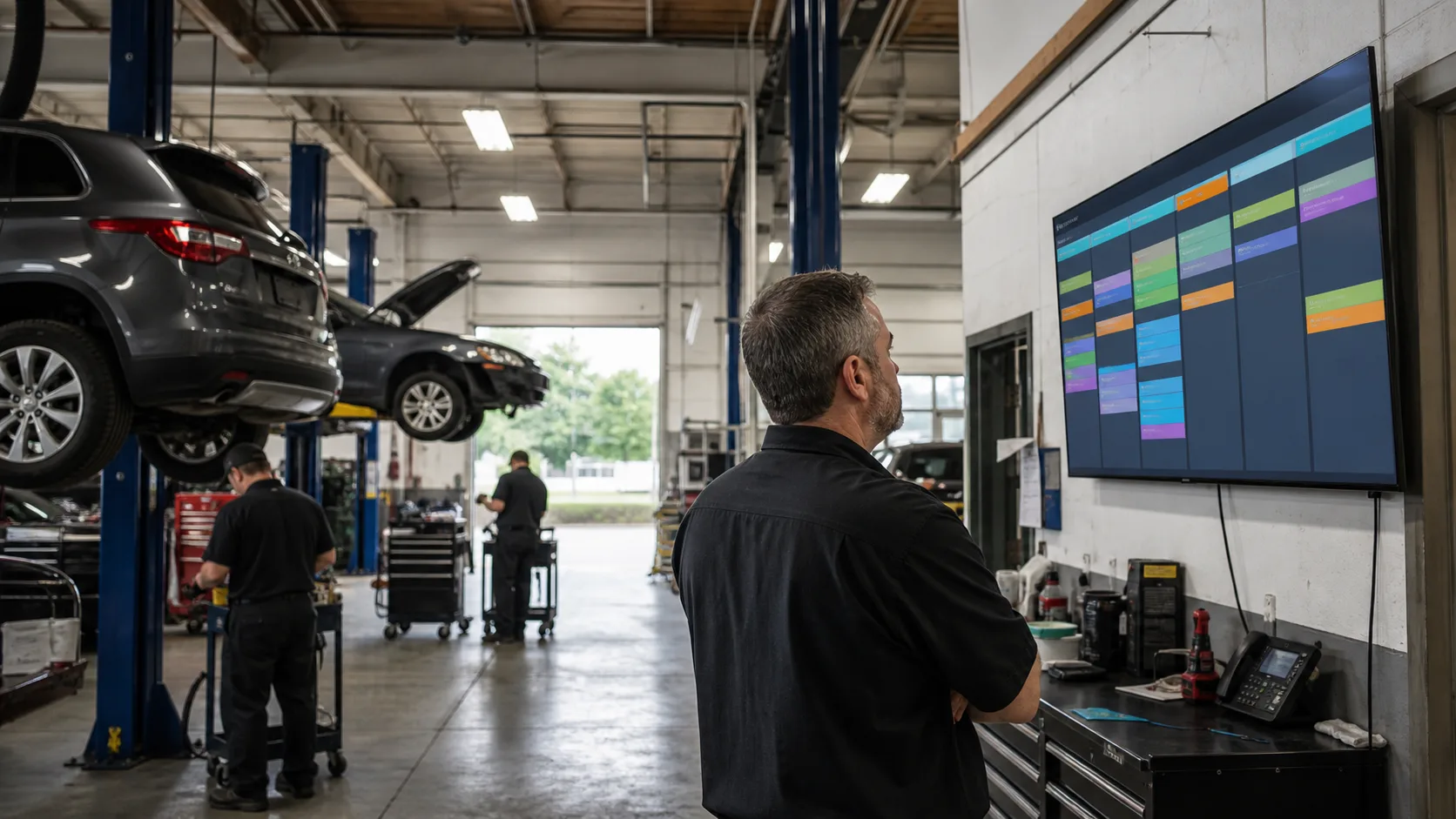
Auto repair shop scheduling is the process of matching the right job to the right tech, bay, time window, and parts status without exceeding the shop's real capacity. It is not the same thing as online appointment booking. Booking gets the customer on the calendar. Shop-floor scheduling decides whether the work can actually happen.
The easiest way to schedule a repair shop better is to stop building the day around car count alone. Start with available technician hours, subtract carryover and blocked time, match work by skill and bay needs, then leave room for diagnostics, approvals, parts delays, and the 4 PM surprise. If the schedule looks full before the day starts, it is probably already overbooked.
I run a six-bay shop with four techs in Littleton, Colorado. Most bad scheduling days do not start with a dramatic mistake. They start with a calendar that looks reasonable at 7:30 AM and stops matching the floor by 10. One diagnostic runs long. A waiter becomes a drop-off. A part that was supposed to arrive before lunch shows up at 3:45. The board still looks organized, but the shop is not.
That is the problem BayBoard is built around.
Booking Is Not Floor Scheduling
Most software talks about scheduling as if it means customer booking. That matters. A clean appointment calendar, reminders, and online booking can help the front counter. They reduce phone tag and give customers a way to request time.
But the appointment calendar is only the first layer.
The floor needs a different schedule. The foreman needs to know who can do the job, which bay is free, whether the alignment rack is tied up, whether the part is here, and what yesterday left behind. The service writer needs to know what can be promised without walking back every thirty minutes. The owner needs to know whether the day is loaded correctly or just busy.
A customer appointment says, "Mrs. Johnson is dropping off at 8 AM."
A shop-floor schedule says, "Mrs. Johnson's brake inspection goes to Chris after the waiting oil change, but only if Bay 2 clears by 9:30 and the parts quote is approved before lunch."
Those are different problems.
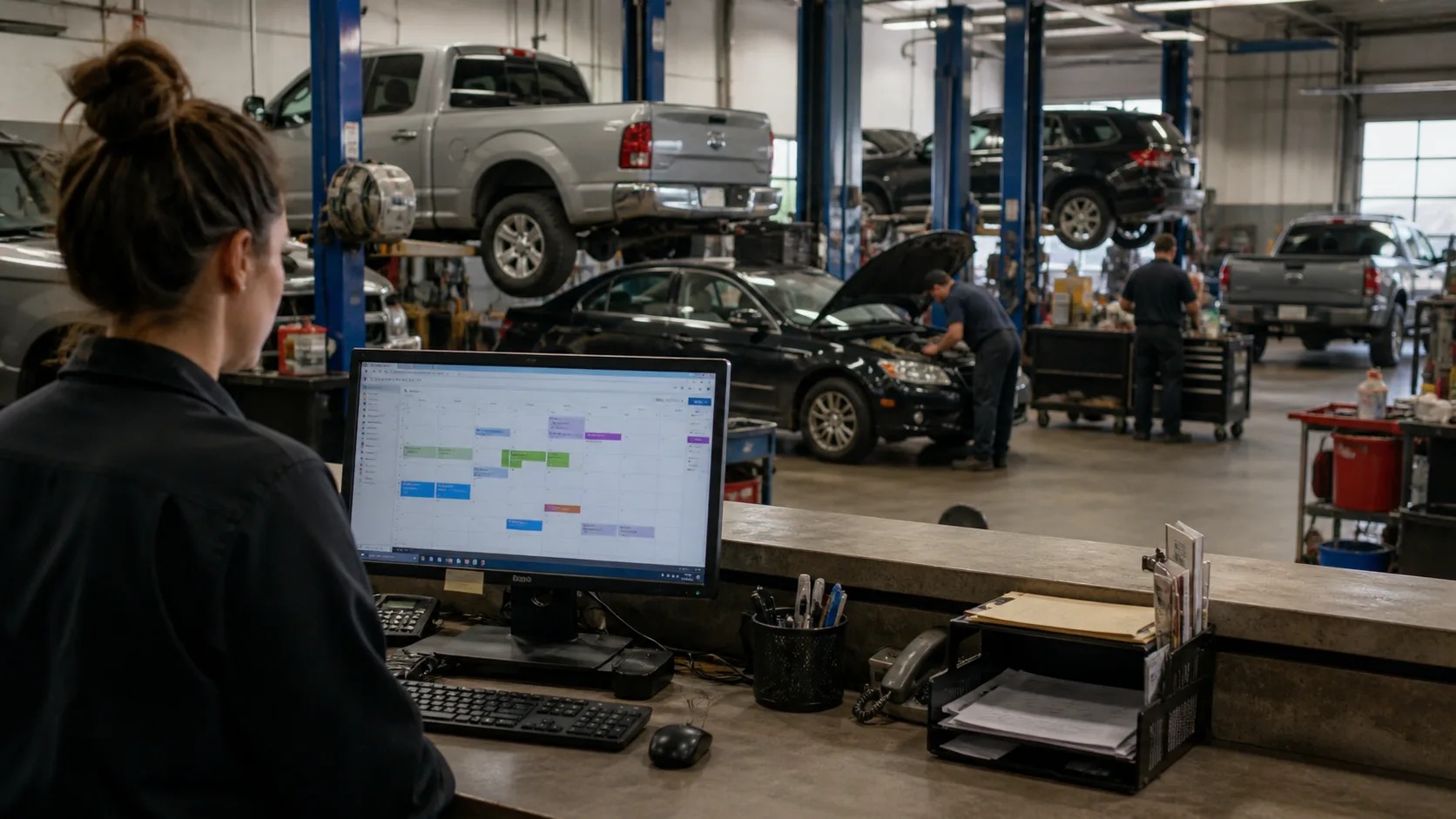
Your shop management system is still the system of record. It owns the customer file, repair order, digital inspection, estimate, invoice, parts, and customer messages. BayBoard sits next to it as the floor schedule. It is where the day gets built around techs, bays, capacity, and carryover. If you are comparing that layer against your current SMS, start with what Tekmetric, AutoLeap, Shopmonkey, Shop-Ware, and Mitchell publicly document for scheduling.
Schedule By Hours, Not Car Count
Car count is easy to see. It is also easy to misread.
Six cars can be a light day if they are inspections, maintenance, and a simple brake job. Six cars can also bury the shop if three are diagnostics, one is a comeback, one needs an approval, and one is waiting on a part that was supposed to arrive yesterday.
Start with labor hours.
For each tech, ask what they can realistically produce today. Not what the clock says. Not what the calendar hopes for. What they can actually absorb based on skill, job mix, interruptions, and the work already sitting in the shop. MOTOR has been teaching this as labor inventory management: scheduling based on billable hours instead of vehicle count.
At a simple level, the math looks like this:
- Start with each tech's available clock hours.
- Subtract lunch, meetings, training, and known interruptions.
- Adjust for the work mix and the tech's skill level.
- Subtract carryover work that must happen first.
- The remainder is what you can book without gambling.
That last number is your bookable capacity.
If you have four techs and eight clock hours each, it is tempting to think you have 32 hours of capacity. You usually do not. One tech may be tied up on a diagnostic. One may leave early. One bay may be blocked by a parts wait. A comeback may need the foreman before anything else moves.
The number that matters is not total hours. It is usable hours.
Match Work by Tech, Bay, and Equipment
The wrong job on the wrong tech is one of the quiet ways a schedule breaks.
A good foreman already knows this. The A Tech should not spend the whole morning on easy maintenance while the B Tech gets a wiring problem they are not ready for. The apprentice should not get buried in a job that needs judgment they have not built yet. The service writer should not promise a same-day diagnostic if the only tech who can handle it is already stacked.
Bay scheduling adds another layer.
Not every bay is equal. One bay may have the alignment rack. One lift may be better for trucks. One corner may be where the scanner and charger live. One bay may be fine for inspections but a bad choice for a job that will sit open overnight.
Then there is bottleneck equipment: the AC machine, alignment rack, scan tool, programming setup, tire machine, or anything else that more than one job can need at the same time.
Good scheduling treats the shop as three capacity layers:
- Technicians: who can do the work.
- Bays: where the vehicle can sit and move.
- Equipment: what the job needs to finish.

If any one of those is wrong, the schedule is wrong.
The bay layer deserves its own treatment because an open lift does not always mean open capacity. If that is the constraint you are trying to fix, read the deeper guide to auto repair bay scheduling.
Plan Carryover Before You Book New Work
Carryover is not leftover work. It is tomorrow's first scheduling input.
This is where a lot of shops lose control. A car does not finish at 5 PM, so it gets pushed into tomorrow mentally. Then tomorrow's appointments show up, the board fills in, and that carryover car becomes the thing everyone works around but nobody scheduled.
That is backwards.
At the end of the day, carryover should be named, assigned, and deducted from tomorrow's capacity before new work is treated as available.
For each carryover job, answer four questions:
- What is the next action?
- Which tech owns it?
- Which bay or holding space does it need?
- How many hours should tomorrow reserve for it?
If a job is waiting on approval, it still needs a plan. If it is waiting on parts, it needs a parts status and a bay decision. If it is torn down, it may be blocking productive space. If it is a comeback, it may need the foreman before anything else happens.
Carryover is not the enemy. Hidden carryover is.
Build Buffer for the 4 PM Surprise
Every shop has a version of the 4 PM surprise.
It is the job that looked small until the estimate was approved late. It is the part that arrives just in time to make the service writer ask, "Can we still get this done today?" It is the waiter who became a drop-off. It is the diagnostic that finally has an answer, but the answer creates two more hours of work.
The schedule has to expect that.
If every tech is booked to the edge of the day, you have no place to put reality. The shop may look efficient in the morning, but the first surprise turns the rest of the day into apology calls and overtime. If this is the pattern you are fighting, the next layer is learning how to stop overbooking mechanics without leaving bays empty.
Buffer does not mean leaving techs idle. It means not pretending every hour is equally predictable.
Diagnostics need more room than maintenance. Waiters need stricter rules than drop-offs. Comebacks need priority because they consume trust as well as bay time. Parts-wait cars need a decision before they become dead space. Repairer Driven News has reported on how parts delays, repair backlogs, and technician shortages stretch repair timelines, which is exactly why the schedule needs room to move.

A good schedule has room to move without hiding slack everywhere.
Better Intake, Better Scheduling
The schedule starts before the car gets to the shop.
If the service writer books a "quick look" with no symptom detail, no warning lights, no timeline, and no idea whether the customer is waiting, the floor pays for it later. The tech gets a vague RO. The foreman has to ask questions that should have been asked on the phone. The customer expects speed because nobody set the job up correctly.
Better intake protects the schedule.
This is not just a BayBoard opinion. MOTOR's service advisor guidance calls out overbooking against technician capacity as a direct source of comebacks, inefficiency, burned-out staff, and lower customer satisfaction in repair shops.
At minimum, the service writer needs to know:
- Is the customer waiting or dropping off?
- Is the vehicle safe to drive?
- Is this maintenance, diagnostic, comeback, or inspection?
- Are parts likely needed before work starts?
- Is there a deadline that actually matters?
- Which tech or bay constraint does this job create?
That does not mean the service writer has to diagnose the car. It means they have to gather enough information to avoid making a promise the floor cannot keep.
The front counter and the foreman need the same picture of the day. If they are looking at different versions, the shop will overbook itself even when everyone is trying to do the right thing.
The labor pressure is not going away. The U.S. Bureau of Labor Statistics projects about 70,000 automotive service technician and mechanic openings each year, on average, from 2024 to 2034. When good tech time is hard to replace, the schedule has to protect it.
Reflow the Day Before It Breaks
The morning schedule is a plan. It is not a contract with reality.
By late morning, you know more than you did at opening. You know which job is stuck, which approval came through, which tech is ahead, which bay is blocked, and which customer promise is at risk.
That is when the schedule should be reflowed.
A simple midday reflow looks like this:
- Check every active job status.
- Identify jobs waiting on approval, parts, or bay access.
- Move carryover and comeback work to the front of the decision list.
- Reassign work if a tech is overloaded or underloaded.
- Decide what gets promised today and what moves.
- Tell the customer before the missed promise tells them for you.
The point is not to make the schedule perfect. The point is to make the next decision visible.
Keep The Schedule Current
A whiteboard works because everyone can see it. That is why shops keep using one even after they buy expensive software. If the board is carrying more of the day than the calendar can, the next question is when the repair shop whiteboard starts breaking.
The problem is not that the whiteboard is dumb. The problem is that it has no memory. It cannot carry yesterday forward automatically. It cannot show the owner what happened from home. It cannot warn the service writer that the only A Tech is already stacked. It cannot keep the same status language across the whole team unless someone constantly maintains it.
Most shops do not need more calendar squares.
They need one place where the floor's reality is visible:
- Which tech owns the job.
- Which bay is tied up.
- Which jobs are waiting on parts or approval.
- What has to carry over.
- Where the day is overloaded.
- What can still move.
That is shop-floor scheduling.
If you are running a repair shop, the goal is not to make the schedule look full. The goal is to build a day your team can actually finish.
If the schedule is already too much for the whiteboard or appointment calendar, you can see how BayBoard prices the floor-scheduling layer on the pricing page.
FAQs
- Should I schedule by car count or labor hours?
- Labor hours are the better starting point. Car count tells you how many keys are on the counter, but labor hours tell you whether the floor can actually absorb the work.
- How much buffer should an auto repair shop leave each day?
- A shop should leave enough buffer for diagnostics, approvals, parts delays, comebacks, and walk-ins. The exact number depends on your team and work mix, but a schedule with no open capacity is usually already overbooked.
- Who should own the daily shop schedule?
- The owner or GM should own the system, but the foreman and service writer need the same live view. If the schedule lives only in one person's head, the shop loses control when that person is busy or out.
- How should carryover work be handled?
- Carryover should be the first input to tomorrow's schedule. Do not treat unfinished work as a side note after new appointments are already booked.
- What is the difference between appointment booking and shop-floor scheduling?
- Appointment booking reserves time with the customer. Shop-floor scheduling decides which tech, bay, job, and time window can actually handle the work.
Want a schedule that handles the real day?
BayBoard shows technician capacity, blocked work, and carryover in one view.
Request Access
Daniel Mallatt
Founder, BayBoard / Owner, Franklynn Automotive
Daniel Mallatt runs Franklynn Automotive, a six-bay repair shop in Littleton, Colorado, and built BayBoard from the scheduling problems he sees on the floor.
Keep reading
Auto Repair Bay Scheduling
How auto repair shops should think about bay scheduling, technician capacity, blocked work, carryover, and same-day movement.
Shop Scheduling Compared
A neutral public-doc comparison of how Tekmetric, AutoLeap, Shopmonkey, Shop-Ware, and Mitchell handle shop scheduling.
Stop Overbooking Techs
A practical way to stop overbooking mechanics by planning technician hours, carryover, job mix, and bay constraints without starving the shop floor.
When Whiteboards Break
Why repair shops still use whiteboards for scheduling, where the board starts breaking, and what a digital shop-floor schedule has to preserve.